Posts Categorized: Uncategorized

Does Homeowners Insurance Cover Foundation Repair? (DFW 2026 Guide)

Quick Answer

Usually no. Standard homeowners insurance policies in Texas exclude foundation damage caused by soil movement, settling, and expansive clay — and those causes are behind the large majority of foundation problems across Dallas-Fort Worth. Insurance may pay when the damage is the result of a sudden, accidental “covered peril,” most commonly a burst or leaking plumbing pipe under the slab. The deciding factor is always the cause of the damage — and your ability to document it.

TL;DR — Insurance & Foundation Repair

  • Standard policies exclude foundation damage from “earth movement,” settling, and expansive soil.
  • Most DFW damage is not covered because North Texas clay shrink-swell is the usual cause.
  • Covered perils that can qualify: sudden plumbing leaks, burst pipes, fire, explosion, vehicle impact.
  • Flooding and earthquakes are never covered by a standard policy — they need separate coverage.
  • A plumbing leak under the slab is the most common path to an approved claim.
  • Documentation wins claims: a dated plumbing test and an engineer’s report are critical.
  • If your claim is denied, 0% financing makes repair affordable — typical DFW repairs run $2,500–$15,000.

Does Homeowners Insurance Cover Foundation Repair?

It depends entirely on what caused the damage. A standard Texas homeowners policy (the HO-3 form most DFW homeowners carry) covers sudden and accidental losses from named perils. It specifically excludes gradual problems — and “earth movement,” soil settling, and expansive-clay shrink-swell are written into nearly every policy as exclusions.

That matters in North Texas more than almost anywhere else in the country. The Blackland Prairie clay under McKinney, Plano, Frisco, Allen, Dallas, Garland, and Fort Worth swells when it’s wet and shrinks when it’s dry. That seasonal movement — not a one-time accident — is what drives most foundation repair in the metro. Because it’s gradual and soil-related, it falls squarely inside the exclusion. You can read more about the mechanism on our causes of foundation problems page.

So the honest answer most DFW homeowners get is: your foundation movement itself is probably not covered — but if a covered event caused it, the picture changes.


What’s Covered vs. What’s Not

Here’s the simplest way to think about it. Insurance follows the cause, not the symptom. A cracked slab is not automatically covered or excluded — it depends on what cracked it.

Cause of foundation damage Typically covered?
Sudden burst or leaking plumbing pipe under the slabOften yes — if sudden & accidental
Fire or explosionYes
Vehicle crashing into the homeYes
Falling tree or heavy objectSometimes
Expansive clay soil swelling and shrinkingNo — earth-movement exclusion
Settling, cracking, or shrinkage over timeNo
Drought drying and shrinking the soilNo
Poor original construction or gradingNo
Tree-root pressure or moisture lossNo
Flooding or surface waterNo — needs separate flood insurance
Earthquake / ground shifting from a quakeNo — needs an earthquake endorsement
Lack of maintenance or poor drainageNo

According to the Insurance Information Institute, earth movement and gradual settling are standard exclusions on home policies nationwide. Texas is no exception.


When Insurance Does Cover Foundation Repair

The most common approved claim in DFW starts under your slab. If a supply line or sewer pipe suddenly fails and washes out or saturates the soil beneath the foundation, the resulting movement can be tied to a covered water-damage event rather than to ordinary settling.

A few realities to understand before you count on it:

  • The leak must be sudden and accidental, not a slow drip that’s been weeping for years. Insurers distinguish hard between the two.
  • Coverage often pays to access and repair the leak (tear-out and plumbing) more readily than it pays to re-level the foundation itself. Policy language varies — read yours.
  • Proof is everything. A dated hydrostatic plumbing test showing the failed line is the single most valuable piece of evidence you can have.

This is one reason every Stratum repair includes a pre-test and post-test plumbing check. Catching a leak isn’t just good engineering — it can be the difference between a denied claim and a covered one. The Texas Department of Insurance covers what standard policies include and exclude in its homeowners coverage guide.


Why Most DFW Foundation Claims Get Denied

If you’ve already been turned down, you’re in the majority — and it usually comes down to one of these:

1. The cause was soil movement

North Texas sits on some of the most expansive clay in the U.S., per the Texas Water Development Board. When the adjuster’s report names “soil movement,” “settling,” or “expansive soil,” the earth-movement exclusion applies and the claim is denied.

2. The damage was gradual

Hairline cracks that widened over several seasons read as wear-and-tear, not a sudden loss. Policies are built to cover accidents, not slow deterioration.

3. There was no covered peril behind it

No burst pipe, no fire, no vehicle — just a sticking door and a stair-step crack in the brick. Without a triggering event, there’s nothing for the policy to attach to.

4. A maintenance or drainage issue contributed

Poor grading, downspouts dumping at the slab, or an unwatered foundation during a Texas drought are considered preventable. Insurers treat them as homeowner responsibility.


Can You Add Foundation Coverage to Your Policy?

Sometimes. A handful of Texas carriers offer optional endorsements that broaden water-damage or slab-leak coverage. These add-ons won’t cover ordinary clay movement, but they can improve your position when a plumbing failure is involved. Ask your agent specifically about:

  • Extended or “expanded” water damage endorsements
  • Slab leak / under-slab plumbing coverage
  • Service line coverage for buried pipes

Read the exclusions page of any quote before you assume foundation work is included. The base policy almost never is.


How to Give Your Claim the Best Chance

If you believe a covered peril caused your foundation problem, the process you follow matters as much as the facts.

  • Document early. Photograph cracks, sticking doors, and any water before anything is touched.
  • Get a plumbing test. A dated hydrostatic test that identifies a failed line is your strongest evidence.
  • Get an engineer’s report. A stamped letter that links the damage to the covered event carries real weight with adjusters.
  • File promptly. Delays let insurers argue the loss was gradual.
  • Keep every record. Save the inspection report, photos, and all written communication.

A free Stratum inspection gives you the marked diagram and documentation you’ll need either way — whether you end up filing a claim or paying out of pocket. See how the visit works on our free foundation inspection page.


What If Insurance Won’t Pay?

For most DFW homeowners, foundation repair ends up being an out-of-pocket investment — and the good news is it’s more affordable than a denied claim makes it feel. Typical repairs in the metro run $2,500 to $15,000 depending on the number of piers and the pier system. You can see the full breakdown in our 2026 DFW pricing guide.

Stratum offers 0% interest financing with no payments for 6, 12, or 24 months through Momnt, so you can stabilize the home now and spread the cost out. We walk through every option — including home equity, pay-at-closing for sellers, and lender programs — in our companion guide, how to pay for foundation repair, and on our financing page.


Key Takeaways

  • Standard Texas homeowners insurance excludes foundation damage from soil movement and settling.
  • Coverage hinges on the cause — a sudden plumbing leak or other covered peril can qualify.
  • Most DFW claims are denied because expansive clay is the underlying cause.
  • Flood and earthquake damage require separate coverage.
  • A dated plumbing test and engineer’s report are your best evidence for a claim.
  • If the claim is denied, 0% financing keeps a $2,500–$15,000 repair manageable.

Frequently Asked Questions

Does homeowners insurance cover foundation repair in Texas?

Usually not. Standard Texas homeowners policies exclude foundation damage caused by soil movement, settling, and expansive clay — the most common causes in DFW. Coverage is possible only when a sudden covered peril, such as a burst plumbing pipe under the slab, caused the damage.

What kind of foundation damage is covered by insurance?

Damage that results from a sudden, accidental covered peril — a burst or leaking pipe under the slab, fire, explosion, or a vehicle striking the home. Gradual cracking and settling from soil movement is excluded.

Why was my foundation insurance claim denied?

The most common reason is that the adjuster attributed the damage to soil movement, settling, or expansive clay, all of which are standard policy exclusions. Claims are also denied when the damage is judged gradual, when no covered peril triggered it, or when a maintenance or drainage issue contributed.

Does insurance cover foundation damage from a plumbing leak?

Often, yes — if the leak was sudden and accidental. A pipe that bursts under the slab and washes out the soil can be tied to a covered water-damage event. A slow leak that weeped for years is typically treated as wear-and-tear and excluded. A dated plumbing test is essential proof.

Does flood insurance cover foundation repair?

Standard homeowners insurance never covers flooding; that requires a separate flood policy through the National Flood Insurance Program or a private insurer. Even then, flood policies have specific rules about foundation elements, so review the terms carefully.

Will adding an endorsement cover my foundation?

Some Texas carriers offer extended water-damage or slab-leak endorsements that can help when a plumbing failure is involved. None cover ordinary expansive-clay movement. Ask your agent to show you the exclusions in writing before assuming foundation work is included.

How do I prove my foundation damage was caused by a covered peril?

Document everything early with photos, get a dated hydrostatic plumbing test to identify a failed line, and obtain a stamped engineer’s report linking the damage to the covered event. File promptly so the insurer can’t argue the loss was gradual.

How much does foundation repair cost if insurance won’t pay?

Most DFW foundation repairs run between $2,500 and $15,000, depending on the number of piers and the system used. Stratum offers 0% interest financing with no payments for 6, 12, or 24 months so you can spread out the cost.

Should I file a claim before or after a foundation inspection?

Get the inspection first. A free Stratum inspection gives you the marked pier diagram, photos, and documentation you’ll need to file a credible claim — and tells you whether a covered peril is even involved before you open a claim.

Does a foundation insurance claim raise my premium?

It can. Filing any claim may affect your rate or renewal, and a denied claim still appears in your loss history. Weigh the likely payout against the long-term premium impact, especially if a covered peril isn’t clearly involved.

Does insurance cover the cosmetic damage after foundation repair?

If the underlying foundation claim is covered, related cosmetic repair may be included; if the foundation cause is excluded, the cosmetic work is too. Either way, Stratum’s sister company Stratum Homeworks handles drywall, paint, and tile touch-up after the lift under one warranty.


Find Out What’s Actually Wrong — Free

Free inspection. Marked pier diagram. The documentation you need for a claim or a quote.

Book My Free Inspection

Call (214) 302-8559 to schedule by phone.


Sources & Methodology

This guide reflects how standard Texas homeowners policies treat foundation damage as of 2026, cross-referenced against the following authoritative sources:

  • Insurance Information Institute (III) — standard policy perils and the earth-movement exclusion (iii.org)
  • Texas Department of Insurance (TDI) — Texas-specific homeowners coverage, exclusions, and endorsements (tdi.texas.gov)
  • Texas Water Development Board — expansive clay soil behavior across North Texas (twdb.texas.gov)
  • Stratum claim-support experience — documentation that has supported approved plumbing-related claims across 5,000+ DFW jobs since 2006

This article is general information, not insurance or legal advice. Coverage depends on your specific policy, carrier, and the facts of your loss — always read your policy and consult your agent.

About Stratum Foundation Repair: Founded 2006. Headquartered at 1402 Custer Rd #904, McKinney, TX 75070. 4.9-star Google rating across 519 reviews from six DFW offices. Lifetime transferable warranty on all pier installations.
How to Pay for Foundation Repair: DFW Financing Options (2026)

Quick Answer

Most Dallas-Fort Worth homeowners pay for foundation repair one of four ways: 0% contractor financing, home equity (a loan or HELOC), cash, or pay-at-closing when selling the home. Stratum offers 0% interest financing with no payments for 6, 12, or 24 months through Momnt, so you can stabilize the home now and spread the cost out. Typical DFW repairs run $2,500 to $15,000, and most homeowners get a financing decision in minutes.

TL;DR — Paying for Foundation Repair

  • Typical DFW repair cost: $2,500–$15,000, depending on piers and system.
  • 0% contractor financing (Momnt): no interest, no payments for 6, 12, or 24 months.
  • Home equity loan / HELOC: lowest rates for larger jobs; uses your home as collateral.
  • Cash-out refinance: rolls the repair into your mortgage if you’re refinancing anyway.
  • Personal loan: fast and unsecured if you don’t have equity.
  • Pay at closing: sellers can pay from sale proceeds — popular with DFW realtors.
  • Insurance rarely pays for clay-driven movement — most repairs are out of pocket.

First, What Does Foundation Repair Cost in DFW?

Before choosing how to pay, it helps to know the number you’re financing. Across the Dallas-Fort Worth metro in 2026, most foundation repairs land between $2,500 and $15,000. The two things that move the price are the number of piers and the pier system your home needs:

Pier system Price per pier Best for
ST1 — Concrete pressed$350–$475Most common DFW slab homes
ST3 — Steel pressed$525–$725Heavier or deeper homes
ST10 — Drilled (engineered)$1,050–$1,650Engineered, high-load projects

A typical 8-to-14-pier exterior job on a single-story slab home falls in the middle of the range. For the full breakdown by city and job size, see our 2026 DFW pricing guide, and learn how the systems differ on our foundation repair systems page.


The 7 Ways to Pay for Foundation Repair

1. 0% Contractor Financing (Most Popular)

This is how the majority of Stratum customers pay. Through Momnt, Stratum offers 0% interest with no payments for 6, 12, or 24 months, plus longer fixed-term loans if you’d rather spread payments over several years. You apply in minutes — often with a soft credit check that doesn’t affect your score to see your options — and a decision comes back fast, so the repair isn’t held up.

It’s the simplest path for most homeowners: no home appraisal, no separate bank visit, and you can start the repair right away. The one rule to remember on a 0% promotional plan is to pay the balance within the promo window to keep it interest-free. See current offers on our financing page. All financing is subject to credit approval; terms are set by the lender.

2. Home Equity Loan or HELOC

If you’ve built equity, a home equity loan or line of credit usually carries the lowest interest rate of any option because it’s secured by your house. A home equity loan gives you a lump sum at a fixed rate; a HELOC works like a credit line you draw from. The trade-offs: it takes longer to close, and your home is the collateral. Good for larger ST3 or ST10 jobs where the total is higher.

3. Cash-Out Refinance

If you were already thinking about refinancing, a cash-out refinance lets you roll the repair into a new, larger mortgage. It can make sense when rates are favorable, but it resets your loan and comes with closing costs — so it’s best when you’re refinancing for other reasons anyway.

4. Personal Loan

No equity? An unsecured personal loan funds quickly and doesn’t put your home on the line. Rates are higher than home-equity options because there’s no collateral, but for a mid-size repair with a short payback, it’s a clean, fast choice.

5. Credit Card (Small Jobs Only)

For a small repair — a few piers or a crack repair — a 0% intro-APR card can work if you’ll clear the balance before the promo ends. Be careful: standard card APRs are high, and carrying a $10,000 balance on a regular card is the most expensive way to pay. Reserve this for small jobs you can pay off fast.

6. Pay at Closing (For Home Sellers)

Selling a home with a foundation problem? Many DFW sellers repair first and pay from the sale proceeds at closing, coordinated through the title company. A completed repair plus a transferable warranty removes the biggest objection buyers have and protects your sale price. Our realtor program handles the documentation agents and title companies need.

7. FHA 203(k) or Renovation Loan (For Buyers)

Buying a home that needs foundation work? A renovation mortgage like the FHA 203(k) lets you fold the repair cost into your purchase loan, so you finance the home and the fix together. It involves more paperwork and eligibility rules, but it can turn a problem listing into the right house at the right price.


Compare the Options at a Glance

Option Best for Typical terms Watch out for
0% contractor financingStarting now, most homeowners0% for 6/12/24 mo; longer loans availablePay within the promo window
Home equity loan / HELOCLarger jobs, lowest rateLow interest, fixed or revolvingSlower to close; home is collateral
Cash-out refinanceAlready refinancingRolled into the mortgageClosing costs; resets loan
Personal loanNo equity, fast fundingFixed term, unsecuredHigher rate than equity
Credit cardSmall jobs only0% intro APR if availableHigh APR if carried
Pay at closingHome sellersPaid from sale proceedsCoordinate with title
FHA 203(k)Home buyersFolded into purchase loanPaperwork, eligibility

Won’t My Insurance Pay for This?

Usually not. Standard Texas homeowners policies exclude foundation damage caused by soil movement and expansive clay — the cause of most DFW problems — so the majority of repairs are paid out of pocket. Insurance may help only when a sudden covered peril, like a burst pipe under the slab, caused the damage. We cover exactly when a claim works (and how to document it) in does homeowners insurance cover foundation repair. Plan your payment method assuming the repair is yours to fund — and treat any insurance payout as a bonus.


What You Need to Get Approved

Contractor financing is designed to be quick. To see your options through Stratum, you’ll generally need:

  • Your repair quote — you get this at the free inspection
  • Basic personal information for the soft credit check
  • A few minutes — most decisions come back during or right after the inspection

For home equity or refinance options, the lender will also want income verification and an appraisal. The fastest path to a number you can act on is simply to book the free inspection — you’ll leave with a marked pier diagram, a fixed all-in price, and your financing options in hand.


Is Financing Foundation Repair Worth It?

Almost always, yes. Foundation movement doesn’t pause while you save up — a $4,000 repair this spring can become a $9,000 repair after another dry summer and a wet fall, because more piers are needed once the movement spreads. Financing lets you stop the damage at today’s price and today’s pier count. And because every Stratum repair carries a lifetime transferable warranty, the money you put in protects the home permanently and follows it to the next owner.


Key Takeaways

  • Typical DFW foundation repair costs $2,500–$15,000.
  • 0% financing through Momnt — no interest, no payments for 6/12/24 months — is the most popular choice.
  • Home equity offers the lowest rate for larger jobs; personal loans are fastest without equity.
  • Sellers can repair now and pay at closing; buyers can use a renovation loan.
  • Insurance rarely covers clay-driven movement, so plan to fund the repair yourself.
  • Repairing sooner locks in today’s price and pier count before the damage spreads.

Frequently Asked Questions

Does Stratum offer financing for foundation repair?

Yes. Stratum offers 0% interest financing with no payments for 6, 12, or 24 months through Momnt, plus longer fixed-term loans. You can apply in minutes and usually get a decision during or right after your free inspection. All financing is subject to credit approval.

What is the best way to pay for foundation repair?

For most homeowners, 0% contractor financing is the simplest — no appraisal, fast approval, and you can start right away. If you have equity and a larger job, a home equity loan or HELOC usually carries the lowest interest rate. Sellers often pay at closing from sale proceeds.

How much does foundation repair cost in DFW?

Most DFW foundation repairs run between $2,500 and $15,000. Price is driven by the number of piers and the system: ST1 concrete pressed piers run $350–$475 each, ST3 steel piers $525–$725, and ST10 drilled piers $1,050–$1,650.

Can I finance foundation repair with bad credit?

Often, yes. Contractor lenders like Momnt evaluate more than a single score, and there are plans for a range of credit profiles. The fastest way to find out is a quick application after your inspection, which can use a soft check that doesn’t affect your score to show your options.

Is 0% foundation repair financing really interest-free?

On a promotional 0% plan, yes — as long as you pay the balance within the promotional window (6, 12, or 24 months). If a balance remains after the promo period, standard interest terms set by the lender apply, so plan to clear it in time.

Should I use a home equity loan for foundation repair?

It’s a strong option for larger jobs because home equity loans and HELOCs typically have the lowest interest rates. The trade-offs are a longer closing process and that your home secures the loan. For smaller or urgent repairs, contractor financing is usually faster.

Can I pay for foundation repair when I sell my house?

Yes. Many DFW sellers repair the foundation first and pay from the sale proceeds at closing, coordinated through the title company. A completed repair plus a transferable warranty removes buyer objections and protects your sale price.

Will foundation repair pay for itself in home value?

Typically the repair protects value more than it adds it — an unrepaired foundation can knock far more off a sale price than the repair costs, and many buyers and lenders won’t proceed without it. The transferable warranty is a selling point for the next owner.

Does insurance ever cover foundation repair?

Only when a sudden covered peril, such as a burst plumbing pipe under the slab, caused the damage. Standard policies exclude soil-movement and settling, which cause most DFW problems. Plan to fund the repair yourself and treat any insurance payout as a bonus.

How fast can I get approved and start the repair?

Contractor financing decisions usually come back within minutes, often during your free inspection. Once you accept the quote and financing, scheduling lead time in DFW averages about 5 to 12 business days.


Get Your Price and Financing Options — Free

Free inspection. Marked pier diagram. Fixed all-in price. 0% financing options in minutes.

Book My Free Inspection

Call (214) 302-8559 to schedule by phone.


Sources & Methodology

Pricing reflects Stratum’s 2026 DFW rates across 5,000+ completed jobs since 2006. Financing descriptions reflect Stratum’s offerings through Momnt and general lending information from the following authoritative sources:

  • Consumer Financial Protection Bureau (CFPB) — home equity loans, HELOCs, and personal lending basics (consumerfinance.gov)
  • U.S. Department of Housing and Urban Development (HUD) — FHA 203(k) renovation loan program (hud.gov)
  • Stratum financing program — current Momnt plan structures and approval process

This article is general information, not financial advice. Rates, terms, and approval depend on the lender and your individual situation. All financing is subject to credit approval.

About Stratum Foundation Repair: Founded 2006. Headquartered at 1402 Custer Rd #904, McKinney, TX 75070. 4.9-star Google rating across 519 reviews from six DFW offices. Lifetime transferable warranty on all pier installations.

How Long Does Foundation Repair Take? A Day-by-Day Timeline for DFW Homeowners    

Quick Answer

Most foundation repair jobs in the Dallas-Fort Worth metro finish in 1 to 3 days on site. A typical 8-to-14-pier exterior job on a single-story slab home wraps in a single day. Two-story homes, interior piers that require tunneling, and engineered drilled-pier projects extend the timeline to 4 to 7 days. The full process — from first call to final paperwork — runs about two to four weeks when you include scheduling, permits, and a post-repair plumbing test.

TL;DR — Foundation Repair Timeline at a Glance

  • Single-story slab, exterior piers only: 1 day on site
  • Two-story slab or jobs with tunneling: 2–4 days on site
  • Engineered ST10 drilled-pier projects: 3–7 days on site
  • Full timeline from inspection to closed paperwork: 2–4 weeks
  • Scheduling lead time in DFW (2026): 5–12 business days
  • Pre-test and post-test plumbing: ~1 hour each
  • Hydraulic lift (per pier set): 45–90 minutes total
  • You can stay in the home every day of the repair.

The Full Foundation Repair Timeline in DFW

Foundation repair is faster than most homeowners expect. The visible work is just the middle of the process. Here is what every stage looks like at Stratum, based on more than 5,000 completed jobs across McKinney, Allen, Frisco, Plano, Dallas, Garland, Fort Worth, and the rest of the metro.

Stage 1 — Free inspection (Day 0)

Time on site: 45 to 75 minutes

A Stratum inspector walks the exterior, takes interior elevation readings with a Zip Level, photographs cracks and door gaps, and reviews the home’s history. You leave the appointment with a marked pier diagram, an all-in price, and your financing options. No high-pressure pitch. Most homeowners book the inspection within 72 hours of calling.

Stage 2 — Quote review and scheduling (Day 1 to Day 7)

Time: Usually 1 to 2 weeks lead time

After you accept the quote, our scheduling team pulls the city permit and books a crew. Lead time in DFW averages 5 to 12 business days in 2026, longer during heavy rainfall weeks when demand spikes. If you need an engineer letter for a lender or buyer, we coordinate that in parallel.

Stage 3 — Pre-test plumbing check (1 day before, or morning of)

Time: 1 to 2 hours

A licensed plumber pressure-tests your supply and sewer lines under the slab. North Texas clay shifts homes enough that hairline leaks are common in homes built before 2000. Catching them now matters: lifting a foundation over a leaking sewer line just resets the problem. The pre-test takes about an hour and runs in parallel with crew setup.

Stage 4 — On-site repair (Day of repair)

This is the day you watch from the kitchen window. Here is the hour-by-hour for a typical 10-pier exterior job on a single-story DFW slab home.

Time What’s happening
7:00 AM Crew arrives, lays plywood, marks pier locations
7:30 AM Excavation begins — small pits roughly 3 ft x 3 ft x 4 ft deep at each pier point
9:30 AM First piers driven using hydraulic ram, pressing 12-inch concrete cylinders down to refusal
11:30 AM All piers pressed to depth; depth recorded for each (typically 12 to 22 ft in DFW)
12:30 PM Hydraulic lift begins — crew slowly raises the beam back to grade in 1/8-inch increments
2:30 PM Beam lift complete, shims and caps installed, doors checked for swing
3:30 PM Backfill, cleanup, walk-through with homeowner
4:30 PM Crew departs; homeowner has signed completion docs

That sequence is the standard ST1 concrete-pressed-pier process. The ST3 steel system follows the same beats but with deeper penetration. The ST10 drilled system replaces the press with augured shafts and concrete pours, which adds 1 to 3 days.

Stage 5 — Post-test plumbing check (Same day or next morning)

Time: 1 to 2 hours

The plumber returns and re-tests the lines. If the lift exposed a leak (uncommon but possible), we coordinate the plumbing repair before paperwork closes. Most homeowners pass both tests with no further work needed.

Stage 6 — Cosmetic repair (Optional, Week 2 to Week 4)

Time: 1 to 3 days, separate appointment

Lifting a foundation closes most cracks but rarely all of them. Drywall hairlines, paint touch-up, brick mortar repair, and tile grout reset are usually scheduled 7 to 14 days after the repair so the home has time to settle into its new position. Our sister company Stratum Homeworks handles all of it under one warranty.


How Long Does Each Pier System Take?

The pier system your engineer specs drives the on-site timeline more than the number of piers. Here is the comparison.

Pier System Piers per Day Typical Job On-Site Notes
ST1 Concrete Pressed 12–18 piers/day 1–2 days Fastest install in DFW; pressed to refusal
ST3 Steel Pressed 8–14 piers/day 2–4 days Deeper penetration; heavier rigging
ST10 Drilled (Engineered) 4–8 piers/day 3–7 days Augured shafts, rebar cages, cured concrete

For a deeper dive into how the three systems differ, see our foundation repair systems page.


What Slows a Foundation Repair Down in North Texas

Most DFW jobs run on schedule. The few that take longer usually run into one of these five issues.

1. Heavy rain

A wet pit can’t be pressed safely. Days with more than half an inch of rain typically push the job 24 to 48 hours. DFW averages two to four rain-delay days per spring (March through May), per National Weather Service Fort Worth records.

2. Tunneling for interior piers

Tunneling under the slab to reach an interior beam adds half a day to a full day per tunnel. Interior-pier jobs that look like 12-pier projects on paper often take 2 to 3 days on site.

3. Surprise plumbing

If the pre-test shows a leak, the repair sequence stops until the line is fixed. Sewer line repair under a slab adds 1 to 3 days. Insurance and city inspection coordination can extend it further.

4. Engineer letter or city inspection lag

Cities like Plano, Frisco, and Allen sometimes inspect the same week. Dallas and Fort Worth can take longer in peak season. If a stamped engineer letter is required by your lender or buyer, allow an extra 7 to 14 days.

5. Old or non-standard construction

Pre-1980 pier-and-beam homes, custom foundations, and homes with original cast iron plumbing run slower because the access points are unpredictable. Estate homes over 4,000 square feet typically need 4 to 7 days on site.


What to Do Before the Crew Arrives

A little prep saves time on repair day. Most homeowners spend about an hour the night before.

  • Move planters, hoses, and patio furniture at least 6 feet away from the foundation along the work area
  • Trim shrubs within 4 feet of the affected beam if you can
  • Pull cars out of the driveway or off the street near pier points
  • Cover or move sensitive interior items on shelves and walls in case of minor vibration during the lift
  • Confirm the gate code or lockbox code (Stratum is a code-access company; we don’t carry HUD/Supra keys)
  • Plan to be home for the walk-through at the end of the day

You can stay in the home during the repair. Most homeowners work from home that day with normal noise tolerance through the morning excavation.


When Can Life Go Back to Normal?

The honest answer: same day for most of it, 2 to 4 weeks for everything.

  • Sleep in the home that night — yes, every night
  • Use the kitchen and bathrooms — yes, normal use as soon as the post-test passes
  • Walk on the new patio dirt — wait 24 hours for backfill to settle
  • Re-hang heavy art and mirrors — wait 7 days so any minor settling finishes
  • Repaint or re-tile — wait 14 days, then call Stratum Homeworks
  • List the home — the day after the post-test passes and the warranty is recorded

Key Takeaways

  • Single-story DFW slab repairs typically finish in 1 day on site
  • Two-story and interior-pier jobs run 2 to 4 days
  • Engineered ST10 drilled projects run 3 to 7 days
  • The full process from inspection to closed paperwork averages 2 to 4 weeks
  • You can stay in the home and use it normally as soon as the post-test passes
  • Rain, tunneling, and surprise plumbing are the only common delay sources

Frequently Asked Questions

How long does a typical foundation repair take in DFW?

Most single-story slab homes are completed in 1 day. Two-story homes and jobs with interior tunneling take 2 to 4 days. Engineered drilled-pier projects on larger homes take 3 to 7 days. The full process including scheduling and post-test runs about 2 to 4 weeks.

Do I have to leave my house during foundation repair?

No. You can stay in the home the entire time and sleep there every night. Water and gas are not shut off in most cases. The morning excavation is the noisiest part — most homeowners work from home through it without trouble.

Can I use the bathroom and kitchen during the repair?

Yes, normal use is fine. The pre-test plumbing check happens before any pressing begins, and the post-test happens after the lift. Both tests take about an hour each and your plumbing is offline during them only.

How long after foundation repair before I can sell my home?

You can list the next business day. The warranty and post-test certificate are typically delivered within 48 hours of the post-test passing. Most DFW realtors prefer to have these documents in hand before opening the MLS listing. See our realtors page for the pre-listing program.

How long does it take to schedule a foundation repair in DFW?

Lead time averages 5 to 12 business days in 2026 once you accept the quote. Spring (March through May) and post-drought fall (September through November) are the busiest seasons and may push lead time to 3 weeks.

How long do the piers themselves last?

A properly installed pier should last the lifetime of the home. Stratum’s lifetime transferable warranty covers every pier we install, and the warranty passes to the next owner at no cost.

What happens if it rains on my repair day?

If light rain, the crew works through it under tarps. If heavy rain — more than half an inch — we reschedule for safety. Pressed piers require a stable pit, and wet excavation compromises the readings. Reschedules typically push the job 24 to 48 hours.

Will the repair damage my landscaping?

Minor disruption is unavoidable along the work area, typically a 3-foot strip around the affected beam. Sod, gravel, and small plants are usually salvaged. Mature shrubs or trees within 4 feet of the foundation occasionally need to be pruned or temporarily moved. The crew restores grade and backfills before leaving.

How long does the lift portion take?

The lift itself is the fastest part of the day. Once piers are pressed to refusal, the crew raises the beam in 1/8-inch increments over 45 to 90 minutes for a typical exterior job. Larger lifts on heavy two-story homes can take 2 to 3 hours.

How long after foundation repair until cracks reopen?

They shouldn’t. A correctly engineered repair on stable piers, paired with drainage improvements if needed, is permanent. New cracks typically point to either a missed plumbing leak or untreated drainage. Both are documented in detail on our causes of foundation problems page.

Can multiple jobs share a crew on the same day?

No. Each Stratum crew works one home per day. Smaller jobs (4 to 6 piers) sometimes wrap by lunch, but the crew still completes paperwork and stays available for any walk-through questions before moving to the next morning’s site.


Get Your Date on the Schedule

Free inspection. 45–75 minutes. Marked pier diagram. Fixed all-in price.

Book My Inspection

Call (214) 302-8559 to schedule by phone.


Sources & Methodology

Timeline figures reflect Stratum’s actual completion data across 5,000+ DFW foundation repair jobs since 2006, cross-referenced against the following authoritative sources:

  • National Weather Service – Fort Worth — rainfall and severe weather records that affect crew scheduling (weather.gov/fwd)
  • City of Plano, Frisco, Allen, Dallas, and Fort Worth permit offices — current permit issuance timelines and inspection windows
  • Foundation Performance Association — installation and lift methodology standards
  • Texas Water Development Board — expansive soil and clay behavior that drives the underlying repair need

Lead times and scheduling windows reflect 2026 DFW market conditions as of the publish date and vary with seasonal demand. All claims about Stratum operations (free inspection length, crew structure, warranty terms) are accurate to the publish date.

About Stratum Foundation Repair: Founded 2006. Headquartered at 1402 Custer Rd #904, McKinney, TX 75070. 4.9-star Google rating across 519 reviews from six DFW offices. Lifetime transferable warranty on all pier installations.


Cost of foundation repair

Cost of foundation repair

Foundation repair is a crucial aspect of home maintenance. It ensures the safety and stability of your property. Understanding the cost of foundation repair is essential for homeowners.

The cost can vary widely. Factors like the extent of damage and type of foundation play a significant role. Knowing these can help you budget effectively.

In Texas, foundation repair costs are often influenced by soil conditions. This makes it important to consider regional variations. Houston, for example, has unique challenges due to its soil.

Getting accurate foundation repair estimates and quotes is vital. It helps avoid unexpected expenses. This guide will provide insights into foundation repair pricing and how to manage costs effectively.

What Is the Average Cost of Foundation Repair?

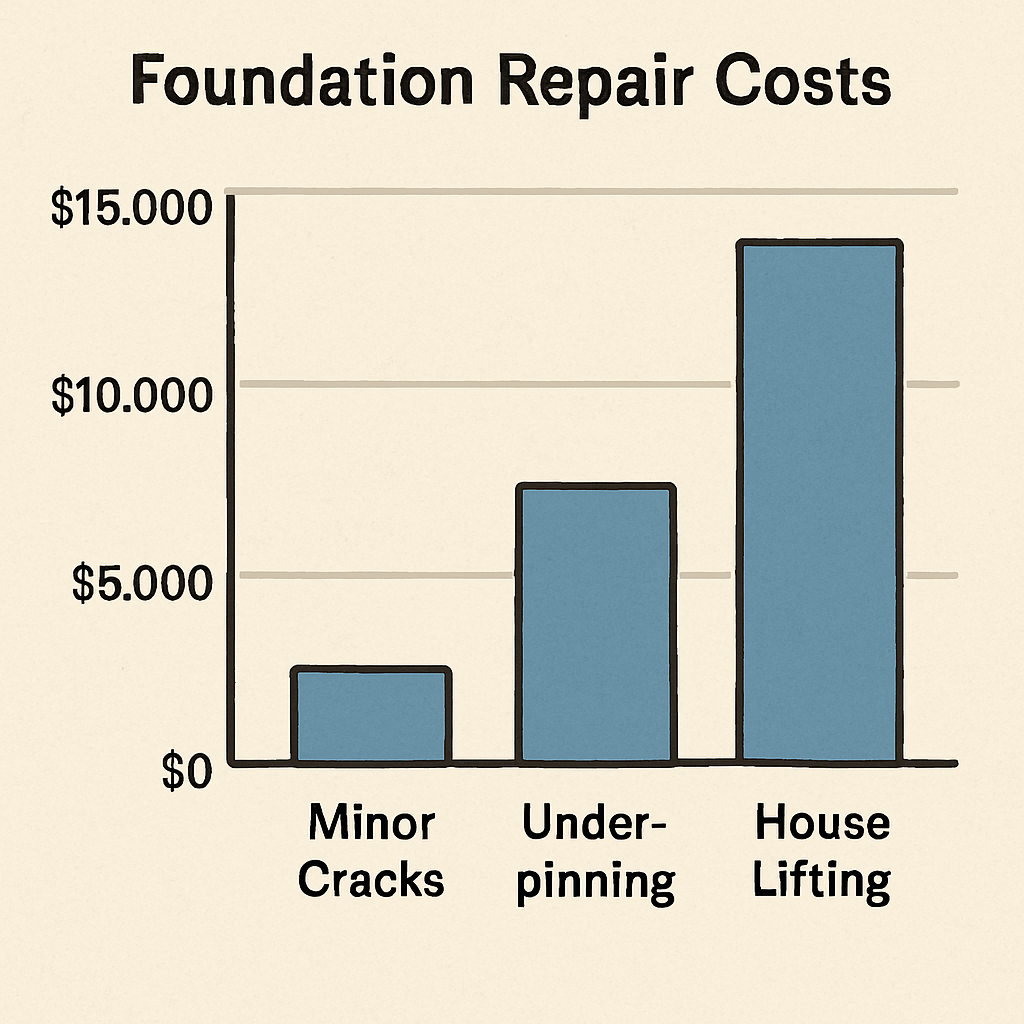
Foundation repair costs can be a significant concern for homeowners. On average, the cost of foundation repair ranges from $2,000 to $7,000. This can fluctuate depending on the severity of the damage.

Minor repairs, such as fixing small cracks, might cost between $500 and $2,500. These costs are considerably lower compared to more extensive repairs. Extensive damage may require underpinning or piers, leading to higher costs.

The average cost of foundation crack repair is usually on the lower end. Yet, complex repairs involving major structural issues will escalate expenses. Here’s a quick list of average costs:

  • Foundation crack repair: $500 – $2,500
  • Basic foundation repair: $2,000 – $7,000
  • Extensive structural repairs: $10,000 or more

Comparison of foundation repair costs

Ultimately, foundation repair costs vary greatly. The specific needs of your home will determine your financial outlay. Proper assessment and timely action can help manage these costs effectively. Regular inspections are beneficial for anticipating repair needs early.

Key Factors That Influence Foundation Repair Pricing

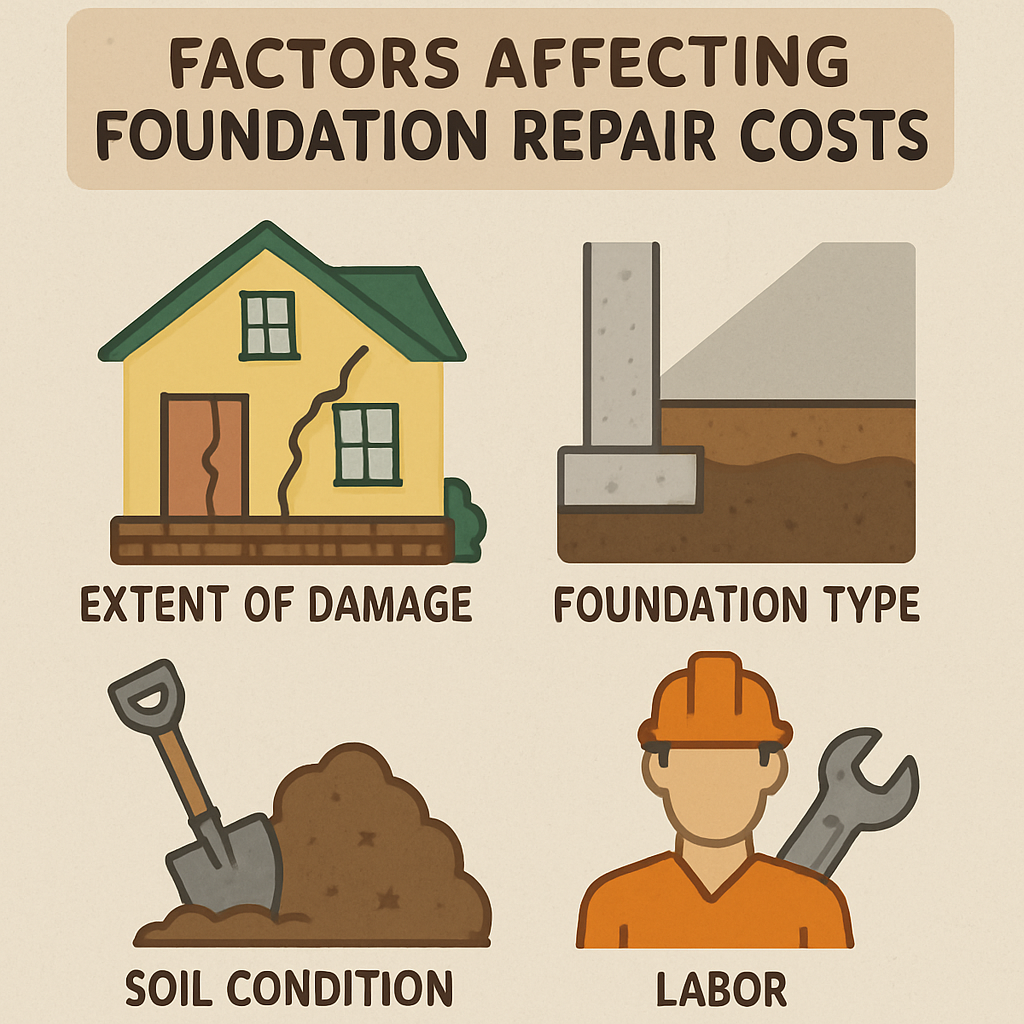
Several key factors influence foundation repair pricing. Understanding these can help you predict your potential expenses. The type of foundation is one crucial element. Repairs for slab foundations often differ in cost compared to pier and beam foundations.

The extent of the damage also plays a major role. Minimal damage typically incurs lower costs. Conversely, severe foundation issues demand more complex solutions and increase costs. Accessibility of the repair site can add to the expenses. Difficult-to-reach areas might require specialized equipment, affecting the overall price.

Below is a list of factors that impact costs:

  • Type of foundation (slab, pier and beam, basement)
  • Severity and extent of damage
  • Accessibility of repair location
  • Need for specialized equipment
  • Additional services such as waterproofing

Illustration of factors affecting foundation repair costs

Climate and soil conditions are additional considerations. For instance, homes in regions with expansive clay soils like Texas may face higher costs. Seasonal weather patterns can further influence the cost of repairs. By understanding these factors, you can make informed decisions and budget effectively.

Foundation Repair Costs by Type and Method

Foundation repair costs vary significantly based on the type and method used. Slab foundations usually require different repair techniques than pier and beam structures. Each method comes with unique challenges and costs that should be considered.

Common repair methods include underpinning, slab jacking, and piering. Underpinning often involves adding support to stabilize the foundation, which can be costly. Slab jacking, however, uses a mix to lift sunken parts, typically costing less. Piering involves inserting steel posts for support, known for its durability and higher expense.

Here’s a list of common repair methods and their estimated costs:

  • Underpinning: $300 to $1200 per pier

The method chosen depends on the specific issues your foundation faces. Consulting with professionals can provide a clearer view of necessary repairs and costs. It’s crucial to choose the right approach to ensure long-term stability and safety for your home. Understanding these methods aids in planning and executing the right repair strategy.

Regional Variations: Foundation Repair Costs in Texas and Dallas

Foundation repair costs in Texas and Houston are often influenced by the unique soil conditions. The expansive clay soil prevalent in these areas can cause significant foundation issues. Repair costs in these locations tend to be higher because of these environmental factors.

Houston, in particular, sees varied repair costs due to its climate and soil. The average cost of foundation repair in Dallas can be higher than in other regions. Seasonal weather changes further complicate the situation, often leading to more significant movement in the soil.

Here are some regional considerations impacting repair costs:

  • Expansive clay soil increases repair costs.
  • High humidity levels affect foundations.
  • Frequent flooding escalates damage risks.

Understanding these regional variations is crucial for homeowners in Texas. Being aware of these factors helps in setting realistic repair budgets. Always consider local conditions when planning foundation repairs.

Getting Foundation Repair Estimates and Quotes

Obtaining multiple foundation repair estimates is essential before proceeding with any project. Detailed quotes help avoid unexpected costs down the road. Additionally, estimates should include a breakdown of labor, materials, and extra services.

It’s important for homeowners to examine each quote closely. Sometimes, the lowest price might lack critical services. Ensure that the contractor’s reputation and experience are considered as well.

Here’s how to get reliable estimates:

  • Consult multiple contractors for quotes.
  • Ensure the estimate includes detailed services.
  • Consider the contractor’s experience and reviews.

The right estimate can guide you in making a sound financial decision. Opt for clarity and transparency when reviewing offers. It’s about balancing cost with quality service.

How to Save on Foundation Repair Costs

Reducing foundation repair costs is possible with some proactive measures. Addressing minor issues quickly can prevent bigger, more expensive problems later.

Regular maintenance and inspections are key. They help identify potential problems early. This can save money on extensive repairs down the line.

Consider these tips to save on costs:

  • Address small cracks immediately.
  • Perform regular checks and upkeep.
  • Select cost-effective repair techniques.

Another way to cut costs is by reviewing multiple repair options. Evaluate the most practical solutions for your specific situation. Remember, investing in timely repairs can ultimately safeguard your home’s value and stability.

Choosing a Foundation Repair Contractor

Selecting the right contractor is crucial for a successful foundation repair. A good choice ensures quality work and fair pricing.

Start by checking credentials and reviews. Compare various contractors to make an informed decision. Ensure the contractor is experienced and insured.

Here’s a handy checklist for evaluating contractors:

  • Verify licenses and insurance.
  • Read customer reviews.
  • Request detailed quotes.

Making a careful choice can lead to a smoother repair process, ensuring peace of mind and long-lasting results.

Conclusion: Investing in Your Home’s Stability

Foundation repair is a crucial investment for maintaining your home’s stability and value. Tackling foundation issues early can prevent costly future repairs.

Understanding the cost factors and obtaining multiple quotes ensures you get the best value. Choose a reputable contractor to guarantee quality work. Prioritizing foundation health today secures your home’s safety for years to come.

Repair settlement cracks

Repair settlement cracks

Settlement cracks are a common issue in many homes. They can appear in brickwork, concrete, drywall, and foundations.

These cracks can be a sign of foundation settling, which may lead to structural problems. Identifying and repairing them early is crucial.

This guide will help you understand how to repair settlement cracks effectively. We will cover various materials and methods.

Whether you’re dealing with minor drywall cracks or significant foundation issues, this article has you covered.

Learn how to assess the damage, choose the right repair method, and when to call a professional.

What Are Settlement Cracks?

Settlement cracks occur when a building shifts over time. This movement is due to the settling of the soil beneath the structure.

These cracks can appear in different parts of a home, including walls, floors, and ceilings. They may start small but can grow larger if not addressed.

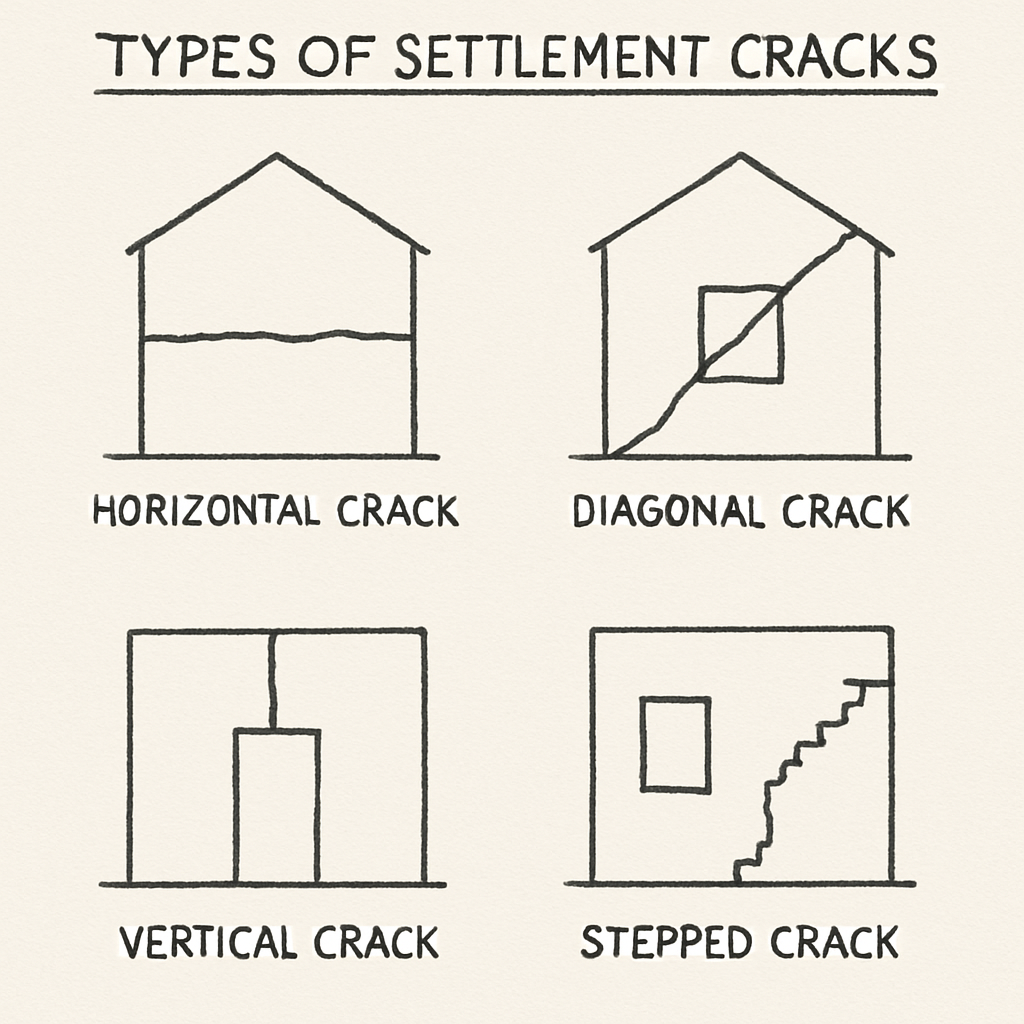
Common types of settlement cracks include:

  • Hairline cracks in drywall
  • Vertical or stair-step cracks in brickwork
  • Horizontal cracks in concrete foundations

Understanding the nature of these cracks helps in determining the necessary repair steps. Identifying settlement cracks early can prevent more severe problems down the line.

Diagram showing different types of settlement cracks

Causes of Settlement Cracks in Homes

Settlement cracks often arise from several key factors affecting your home’s foundation. Soil conditions play a significant role in this process.

Common causes of settlement cracks include:

  • Expansive clay soil that swells and contracts
  • Poor drainage leading to waterlogged soil
  • Foundation construction on uneven ground

Seasonal changes can further worsen the situation, causing the soil to freeze, thaw, and shift. Additionally, inadequate construction practices at the outset can make a foundation more susceptible to cracking.

Awareness of these causes can aid in prevention and prompt action when issues are first noticed. Regular inspection is essential for early detection.

How to Identify and Assess Settlement Cracks

Identifying settlement cracks involves examining various materials for specific signs. Different materials exhibit distinct crack patterns. Each requires careful observation.

Key steps in identifying settlement cracks:

  • Inspect walls and floors for visible cracks.
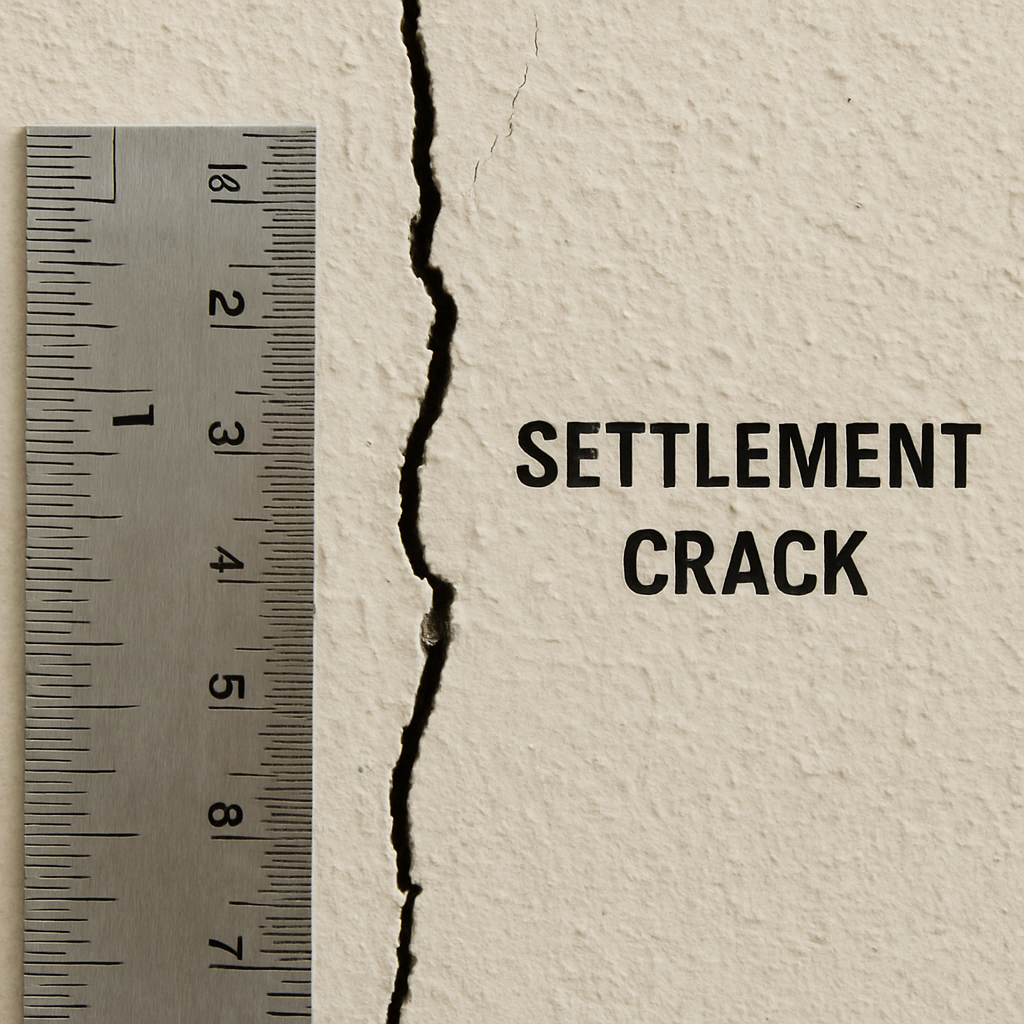
  • Measure crack width and note any changes over time.
  • Determine if cracks are vertical, horizontal, or diagonal.

Assessing the severity of these cracks is crucial. Minor hairline cracks might not need immediate repair, while wider cracks suggest significant issues. Monitoring crack progression helps in evaluating if the foundation is stable or worsening.

Regular documentation, including photographs and measurements, provides a helpful record of any changes. This practice supports informed decision-making on necessary repairs.

Close-up of settlement cracks with a ruler for scale

How to Repair Settlement Cracks in Drywall

Repairing settlement cracks in drywall is often straightforward. Start by sanding the area lightly. This removes any rough edges.

Next, apply joint compound to fill the crack. A putty knife smooths out the surface. Let the compound dry completely.

Once dry, sand the area again for an even finish. Apply a second coat if needed. This ensures the surface is perfectly smooth.

Finish by painting over the repair to match the surrounding wall. This completes the task, making the cracks invisible. Regular checks prevent future damage.

Steps to repair drywall cracks:

  • Sand rough edges
  • Apply joint compound
  • Sand again and repaint

How to Repair Settlement Cracks in Brickwork

Fixing settlement cracks in brickwork requires careful attention. First, clear out loose mortar and debris using a chisel or a stiff brush. This prepares the surface for new mortar.

Next, mix fresh mortar to a smooth consistency. Fill the cleaned cracks with the mortar using a pointing trowel. Ensure the mortar is packed firmly.

Smooth the surface to align with the original brickwork. Allow the mortar to set for a day before touching it. This ensures durability and a seamless look.

Steps for repairing brickwork cracks:

  • Remove old mortar
  • Mix and apply new mortar
  • Align and smooth the surface

How to Repair Settlement Cracks in Concrete

Concrete cracks are common and need prompt attention. Start by cleaning the crack thoroughly. Use a wire brush or pressure washer to remove dirt and debris. Clean surfaces allow for better adhesion of repair materials.

For smaller cracks, a concrete crack filler or epoxy injection is typically sufficient. Choose the appropriate compound based on the depth and width of the crack. Fill the crack completely, ensuring there are no air bubbles.

Allow the repair material to cure as per the manufacturer’s instructions. This step is crucial for ensuring the longevity of the repair. Proper curing prevents future issues.

Steps to repair concrete cracks:

  • Clean the crack
  • Choose an appropriate filler
  • Allow adequate curing

How to Repair Settlement Cracks in Foundation

Foundation cracks can pose significant risks to your home’s structural integrity. Begin by accurately assessing the extent and type of cracks. Use a level to check for alignment issues, as misalignment can indicate severe settling.

For hairline or minor foundation cracks, a flexible foundation repair compound often suffices. Apply the compound with a trowel, smoothing it evenly across the crack. For significant cracks, professional assessment and repair may be necessary, such as underpinning or wall anchors.

Regular monitoring of your foundation can help prevent future damage. Addressing small issues early is key to avoiding costly repairs later. Keep a maintenance log to track crack developments.

Foundation crack repair steps:

  • Assess crack severity
  • Use repair compounds for minor issues
  • Consider professional help for major cracks

When to Call a Professional for Foundation Settling Repair

Sometimes, DIY repair may not be enough for foundation problems. If you notice large cracks over 1/4 inch wide, or if they are expanding quickly, it’s time to call a pro. They can properly assess the issue and provide tailored solutions.

Visible shifts in your foundation or stuck doors and windows are also red flags. These signs may indicate severe structural damage needing expert attention.

Indicators to call a professional:

  • Cracks wider than 1/4 inch
  • Rapidly expanding cracks
  • Noticeable shifts in foundation

How Much Does It Cost to Repair Settlement Cracks?

The cost to repair settlement cracks varies widely. It depends on the severity and type of damage present. Minor DIY fixes might cost less than $100 for materials, while major repairs can run into thousands.

Professional foundation repair often includes inspection fees and labor costs. Keep in mind, investing in proper repair now can save significant amounts later.

Factors affecting repair costs:

  • Severity of the cracks
  • Type of repair method needed
  • Professional labor and inspection fees

Preventing Future Settlement Cracks

Proactively preventing settlement cracks can save you time and expense. Regular maintenance and inspection are key components. Address minor issues before they escalate into major problems.

Focus on moisture control to protect your foundation. Ensure proper drainage around your home and maintain consistent soil moisture levels.

Additional preventive measures include:

  • Regular home inspections
  • Promptly sealing small cracks
  • Reinforcing foundations as needed

By implementing these strategies, you can help safeguard your home against future settlement issues.

Key Takeaways and Final Tips

Tackling settlement cracks early is vital for home maintenance. Understanding and implementing proper repair techniques can save you money and stress.

Consider the following final tips:

  • Regular inspections are critical.
  • DIY for minor cracks, professional help for major ones.
  • Always address moisture issues promptly.

Why does my foundation move each summer in Dallas

Understanding Foundation Shifting and How to Fix It

If you’re a homeowner in Dallas, you may have noticed something odd. Each summer, your house seems to move.

This isn’t an illusion. It’s a common issue known as foundation shifting.

Dallas’ unique soil composition and seasonal weather changes contribute to this phenomenon. The expansive clay soils in the region expand and contract with moisture changes, leading to foundation movement.

Ignoring this issue can lead to serious structural damage. It’s crucial to understand the signs of foundation problems and take action promptly.

In this article, we’ll explore why foundation shifting occurs in Dallas, how to recognize it, and what you can do about it. Whether you’re currently facing this issue or want to prevent future foundation problems, this guide is for you.

Understanding Dallas Soil and Foundation Shifting

The soil beneath your home plays a significant role in foundation stability. In Dallas, the soil composition is unique.

It’s primarily made up of expansive clay. This type of soil has a high capacity for water absorption and retention

When this clay absorbs water, it expands. Conversely, when it dries out, it contracts. This constant cycle of expansion and contraction can cause the ground to shift.

As a result, the foundation of your home may move. This is what we refer to as foundation shifting.

  • Key factors influencing foundation shifting in Dallas:
  • Unique soil composition
  • Seasonal weather changes
  • Water absorption and retention capacity of the soil

The Role of Expansive Clay in Foundation Movement

Expansive clay is a double-edged sword. On one hand, its ability to retain water helps keep the soil moist.

On the other hand, its expansion and contraction can lead to instability. This instability is what causes the foundation to shift.

Understanding this behavior of expansive clay can help homeowners take preventative measures.

Seasonal Weather Patterns and Soil Moisture

Dallas experiences a wide range of weather patterns. These patterns significantly affect soil moisture levels.

In the spring, heavy rains saturate the soil, causing it to expand. Come summer, the heat dries out the soil, leading to contraction.

This cycle of expansion and contraction throughout the seasons contributes to foundation shifting.

Recognizing Signs of Foundation Problems

Foundation shifting is not always immediately noticeable. However, there are signs that homeowners can look out for.

These signs can be both inside and outside the home. They are often subtle at first, but become more apparent over time.

  • Common signs of foundation problems:
  • Cracks in walls or floors
  • Doors and windows that stick or won’t close properly
  • Uneven or sloping floors
  • Gaps around window frames or exterior doors

Interior Indicators of Foundation Shifting

Inside the home, look for cracks in the walls or floors. These are often the first signs of foundation shifting.

Doors and windows that stick or won’t close properly can also indicate a problem. This happens when the shifting foundation distorts the frames.

Exterior Indicators of Foundation Issues

Outside, check for gaps around window frames or exterior doors. These gaps can appear when the foundation shifts.

Also, look for cracks in the exterior brickwork or foundation itself. These are clear signs of foundation problems.

The Consequences of Ignoring Foundation Shifting

Ignoring foundation shifting can lead to serious problems. Over time, the shifting can worsen, causing more damage.

This damage can be costly to repair. It can also make your home unsafe to live in.

In the worst cases, the home may become uninhabitable. This is why it’s crucial to address foundation problems early.

Structural Damage and Safety Concerns

Structural damage is a major concern with foundation shifting. As the foundation moves, it can cause walls to crack and floors to slope.

In severe cases, the home may even start to lean. This can pose a serious safety risk.

If left unchecked, the damage can become so severe that the home is unsafe to live in.

Impact on Property Value and Insurance

Foundation problems can also impact your property value. Potential buyers may be deterred by the signs of foundation issues.

Additionally, some insurance policies may not cover damage caused by foundation shifting. It’s important to understand your coverage.

Preventative Measures and Maintenance Tips

Preventing foundation shifting is better than dealing with its aftermath. There are several steps homeowners can take to protect their homes.

These include maintaining proper drainage, landscaping, and regular inspections.

Proper Drainage and Landscaping

Proper drainage is crucial in preventing foundation shifting. It helps maintain consistent soil moisture levels.

Landscaping can also play a role. For instance, planting trees too close to the house can affect soil moisture.

Conversely, well-planned landscaping can help manage soil conditions around the foundation.

Regular Inspections and Early Intervention

Regular inspections can help detect foundation problems early. Look for signs like cracks in walls or uneven floors.

If you notice any issues, seek professional help immediately. Early intervention can prevent further damage.

Remember, ignoring the problem won’t make it go away. It will only get worse over time.

Professional Foundation Repair Solutions in Dallas

When preventative measures aren’t enough, professional intervention is necessary. Foundation repair is a complex process that requires expertise and precision.

In Dallas, several methods are commonly used to address foundation shifting.

Common Repair Methods for Dallas Homes

Underpinning is a popular method. It involves strengthening the foundation by extending it deeper into the ground.

Mudjacking is another option. It involves pumping a cement mixture under the foundation to lift it back into place.

Pier and beam adjustments can also be effective, especially for homes built on pier and beam foundations.

Choosing the Right Foundation Repair Company

Choosing the right repair company is crucial. Look for a company with a strong reputation and experience in Dallas.

Remember, the cheapest option isn’t always the best. Quality work can save you money in the long run.

Conclusion: Protecting Your Home Against Foundation Shifting

Understanding foundation shifting in Dallas is the first step to protecting your home. With knowledge, you can take proactive measures and seek professional help when needed.

Remember, a stable foundation is key to the safety and value of your home. Don’t overlook its importance.

Can I sell my home with foundation issues

Selling a home is a complex process. It becomes even more challenging when the property has foundation issues.

Foundation problems can significantly impact a home’s value. They can also affect the buyer’s ability to secure financing.

But does this mean you can’t sell a home with foundation issues? Not at all.

In this article, we’ll explore the ins and outs of selling a home with foundation problems. We’ll discuss the impact on value, the legal requirements for disclosure, and the options available to sellers.

Whether you’re a homeowner looking to sell or a real estate agent assisting a client, this guide will provide valuable insights.

So, let’s dive in and answer the question: Can I sell my home with foundation issues?

Understanding Foundation Issues and Their Impact on Home Sales

Foundation issues are a common concern in real estate. They can arise due to various factors such as soil conditions, water damage, and poor construction.

These problems can range from minor cracks to major structural damage. Regardless of the severity, they can significantly affect a home’s value and saleability.

Here are some key points to understand about foundation issues and their impact on home sales:

  • Foundation issues can deter buyers, making the home harder to sell.
  • They can also affect the buyer’s ability to secure financing.
  • In most states, sellers are legally required to disclose any known foundation issues.
  • The cost of repairing foundation issues can be high, which can affect the home’s price.

Understanding these factors is crucial when selling a home with foundation issues.

Types of Foundation Problems

There are several types of foundation problems. Some are more serious than others.

Cracks are the most common type of foundation issue. They can appear in the walls, floors, or the foundation itself.

Settlement issues are another common problem. This happens when the soil beneath the foundation shifts, causing the house to sink or tilt.

Bulging or bowing walls can also indicate foundation problems. This is often caused by soil pressure against the foundation walls.

Understanding the type and extent of your foundation issues can help you make informed decisions when selling your home.

How Foundation Issues Affect Property Value

Foundation issues can significantly affect a home’s value. Buyers are often wary of potential repair costs and may offer less for a home with known problems.

In some cases, foundation issues can reduce a home’s value by 10-20%. The exact impact depends on the severity of the issues and the local real estate market.

It’s also important to note that foundation issues can affect a home’s appraisal value. This can impact the buyer’s ability to secure a mortgage.

Despite these challenges, it’s still possible to sell a home with foundation issues. The key is to understand the impact on value and plan your selling strategy accordingly.

Legal Requirements for Disclosure

In most states, sellers are legally required to disclose any known foundation issues. Failure to do so can lead to legal consequences.

Disclosure laws vary by state. Some require a written disclosure statement, while others rely on verbal disclosure.

Regardless of the specific laws in your area, honesty is the best policy. Full disclosure can protect you from potential lawsuits and build trust with potential buyers.

It’s also a good idea to document any repairs or assessments related to the foundation issues. This can provide transparency and reassure potential buyers.

Preparing to Sell Your Home with Foundation Issues

Selling a home with foundation issues requires careful planning. The first step is to assess the extent of the issues.

Home inspection for foundation issues

A pre-sale home inspection can help identify any foundation problems. It’s also a good idea to hire a structural engineer for a detailed assessment.

Once you understand the issues, you can weigh your options. These might include repairing the issues before selling, selling the home as-is, or adjusting the price to account for the repair costs.

Here are some key steps to prepare your home for sale:

  • Get a pre-sale home inspection.
  • Hire a structural engineer for a detailed assessment.
  • Consider getting estimates for repair costs.
  • Consult with a real estate agent experienced in selling homes with foundation issues.
  • Understand your legal obligations for disclosure.

The Pros and Cons of Repairing Before Selling

Repairing foundation issues before selling can have both pros and cons. On the positive side, it can make your home more attractive to buyers and potentially increase its value.

However, foundation repairs can be costly. The cost can range from a few thousand dollars for minor issues to tens of thousands for major repairs.

Another factor to consider is time. Foundation repairs can take weeks or even months to complete, which can delay your sale.

In some cases, buyers may prefer to handle the repairs themselves. They might want to choose their own contractor or oversee the work.

Ultimately, the decision to repair before selling depends on your financial situation, timeline, and the local real estate market.

Selling As-Is: What You Need to Know

Selling a home as-is means selling it in its current condition, without making any repairs. This can be an option if you can’t afford to fix the foundation issues or if you need to sell quickly.

However, selling as-is can have drawbacks. It can limit your pool of potential buyers, as some buyers may not want to take on a home with known issues.

It can also affect the price. Buyers will likely factor in the cost of repairs when making an offer, which can lead to lower offers.

Despite these challenges, selling as-is can be a viable option. It’s important to price the home appropriately and to be transparent with potential buyers about the issues.

Marketing Your Home with Foundation Issues

Marketing a home with foundation issues can be a challenge. However, with the right strategy, you can still attract potential buyers.

Marketing a home with foundation issues

One key aspect is transparency. It’s important to disclose the foundation issues upfront. This can help build trust with potential buyers and avoid legal issues down the line.

At the same time, don’t let the foundation issues define your home. Highlight the other strengths of your property, such as its location, size, or unique features.

Highlighting Your Home’s Strengths

Every home has its strengths. Even if your home has foundation issues, it likely has other features that can attract buyers.

Perhaps your home is in a desirable location, has a large yard, or boasts a recently renovated kitchen. These are all selling points that can offset the foundation issues.

Staging your home effectively can also help. A well-staged home can make a strong impression on buyers, drawing their attention away from the foundation issues.

Finally, remember to use high-quality photos and a compelling property description in your listing. These can help showcase your home’s strengths and make it stand out from the competition.

Pricing Strategy and Negotiation Tips

Pricing a home with foundation issues can be tricky. You’ll need to take into account the cost of repairs, as well as the impact on your home’s value.

One strategy is to price your home slightly below market value. This can attract more buyers and potentially lead to multiple offers.

Be prepared for negotiations. Some buyers may request a reduction in the sale price to account for repair costs. Having estimates from contractors can help you negotiate effectively.

Finally, consider working with a real estate agent experienced in selling homes with foundation issues. They can provide valuable advice on pricing and negotiation strategies.

Closing the Deal: From Offers to Escrow

Closing a deal on a home with foundation issues can be a complex process. It often involves negotiations, inspections, and potentially, financing challenges.

Once you receive an offer, be prepared for negotiations. Buyers may request a price reduction or ask for repairs to be made before closing. Having a clear understanding of your home’s value and the cost of repairs can help you navigate these negotiations effectively.

During the escrow period, the buyer’s lender may require a home inspection and appraisal. These can reveal additional issues and potentially affect the sale price or the buyer’s ability to secure financing.

Despite these challenges, remember that many homes with foundation issues have been successfully sold. With patience, transparency, and a good strategy, you can close the deal on your home.

Understanding Buyer Concerns and Financing Challenges

Buyers of homes with foundation issues often have specific concerns. They may worry about the cost of repairs, the safety of the home, and the potential impact on the home’s future resale value.

Financing can also be a challenge. Some lenders may be hesitant to approve a mortgage for a home with significant foundation issues. This can limit your pool of potential buyers.

However, there are ways to address these concerns. Providing detailed information about the foundation issues and any repairs can help alleviate buyer concerns. Offering creative financing options or seller credits can also help overcome financing challenges.

Remember, every buyer is different. Understanding their concerns and being flexible in your approach can help you close the deal.

The Role of Home Inspections and Appraisals

Home inspections and appraisals play a crucial role in the sale of a home with foundation issues. They can reveal the extent of the issues and impact the sale price and the buyer’s ability to secure financing.

A home inspection can identify any additional issues that need to be addressed. This can lead to further negotiations or even a potential cancellation of the sale.

An appraisal determines the value of your home. If your home appraises for less than the sale price, the buyer’s lender may not approve the loan.

Despite these potential challenges, remember that inspections and appraisals are standard parts of the home selling process. Being prepared and understanding their role can help you navigate the process more smoothly.

Conclusion: Moving Forward with Confidence

Selling a home with foundation issues can be a challenging process. However, with the right approach and a clear understanding of your options, it is entirely possible.

Remember, transparency is key. Disclose all known issues to potential buyers and provide detailed information about any repairs. This can help build trust and facilitate negotiations.

Finally, stay patient and flexible. The process may take longer than a typical home sale, but with persistence and a positive outlook, you can successfully sell your home and move forward with confidence.

DO I NEED TO WATER MY FOUNDATION?

Essential Tips to Protect Your Home’s Structural Integrity

Homeowners often overlook one crucial aspect of home maintenance: foundation watering.

Yet, it plays a vital role in preserving the structural integrity of your home.

In areas with expansive clay soils, foundation watering becomes even more critical. The moisture level in the soil can significantly impact the stability of your foundation.

This guide aims to shed light on foundation watering requirements. It will help you understand when and how to water your foundation effectively.

We will also delve into the importance of a watering schedule in foundation care.

Whether you’re a DIY enthusiast or a homeowner seeking to prevent costly repairs, this guide will equip you with the knowledge you need.

Why Foundation Watering is Essential

The foundation is the backbone of your home. It supports the entire structure, keeping it upright and stable.

However, the soil around your foundation can expand and contract with changes in moisture levels. This movement can put stress on your foundation, leading to cracks and other damage.

Foundation watering helps maintain consistent soil moisture levels. This consistency prevents the soil from expanding and contracting too drastically.

In areas with expansive clay soils, these changes can be particularly severe. Regular foundation watering can help mitigate these risks.

In essence, foundation watering is a preventative measure. It helps maintain the health of your foundation, preventing costly repairs down the line.

Recognizing the Need for Foundation Watering

Recognizing the need for foundation watering is crucial in foundation care. Certain signs can indicate that your foundation may need watering.

One common sign is soil pulling away from the foundation. This indicates that the soil is drying out and shrinking, which can put stress on your foundation.

Another sign is the appearance of cracks in your foundation or in the walls of your home. These can be a result of the soil shifting due to changes in moisture levels.

Here are some signs that your foundation may need watering:

  • Soil pulling away from the foundation
  • Cracks in the foundation or walls
  • Doors and windows sticking or not closing properly
  • Uneven or sloping floors
  • Gaps around window frames or exterior doors

If you notice any of these signs, it may be time to start a foundation watering routine.

Understanding Your Soil Type and Its Impact

The type of soil around your home plays a significant role in foundation watering requirements. Different soil types have varying water retention capabilities.

For instance, clay soils retain water for longer periods. This can lead to expansion when wet and contraction when dry, affecting the foundation.

On the other hand, sandy soils drain water quickly. This can lead to a lack of moisture around the foundation, causing it to settle or shift.

Expansive Clay Soil and Foundation Care

Expansive clay soil is particularly challenging for foundation care. When it gets wet, it expands, exerting pressure on the foundation.

When it dries out, it contracts, creating gaps where the foundation can settle. This constant movement can lead to foundation damage.

Therefore, maintaining consistent soil moisture levels is crucial when dealing with expansive clay soils.

Loam and Sandy Soils: Watering Considerations

Loam and sandy soils present different challenges. They drain water quickly, which can lead to a lack of moisture around the foundation.

This can cause the foundation to settle or shift, leading to potential damage. Therefore, these soil types may require more frequent watering to maintain adequate moisture levels.

However, over-watering should be avoided as it can lead to other issues such as soil erosion or water pooling around the foundation.

Creating an Effective Watering Schedule

Creating an effective watering schedule is key to maintaining the stability of your foundation. This schedule should consider the type of soil, climate, and seasonal changes.

The goal is to maintain consistent soil moisture levels around your foundation. This helps to prevent soil contraction and expansion that can damage the foundation.

Remember, the watering schedule is not set in stone. It should be flexible and adaptable to changes in weather conditions and soil moisture levels.

Seasonal Adjustments to Your Watering Routine

Seasonal changes can significantly impact soil moisture levels. For instance, during dry summer months, you may need to water more frequently.

On the other hand, during rainy seasons, you may need to cut back on watering to prevent over-saturation.

Tools for Maintaining Soil Moisture

There are several tools available to help maintain soil moisture levels. Soaker hoses and automatic drip systems can provide consistent watering around your foundation.

Additionally, a moisture meter or soil probe can be used to monitor soil moisture levels and adjust your watering schedule accordingly.

The Risks of Over-Watering and Under-Watering

Over-watering and under-watering both pose risks to your foundation. Over-watering can lead to soil oversaturation, causing the soil to expand excessively and exert pressure on the foundation.

Conversely, under-watering can cause the soil to contract, creating gaps between the soil and the foundation. This can lead to foundation instability and potential damage.

Integrating Water Conservation into Foundation Care

While foundation watering is crucial, it’s also important to consider water conservation. This can be achieved by using efficient watering systems like soaker hoses or drip irrigation systems.

These systems deliver water directly to the soil, reducing evaporation and ensuring that your foundation gets the moisture it needs without wasting water.

When to Seek Professional Assessment

If you notice signs of foundation damage, such as cracks or sinking, it’s time to seek professional help. These signs could indicate serious issues that require expert attention.

A professional can assess your foundation and provide guidance on the best watering practices for your specific situation.

Conclusion: The Importance of Regular Foundation Maintenance

Regular foundation maintenance, including proper watering, is crucial for the longevity of your home. It helps prevent costly repairs and maintains the value of your property.

In conclusion, understanding your foundation watering requirements and adhering to them is an essential part of home care. It’s a small effort that yields significant benefits.

Signs of Foundation Problems in McKinney

Signs of Foundation Problems in McKinney, TX

Your home is your sanctuary, a place where you feel safe and secure.

But what if the very foundation of your home is at risk?

Foundation Repair McKinney Texas is a common issue many homeowners face. These problems can be due to various factors, including the expansive clay soil prevalent in the region.

brown and white concrete house near green trees under blue sky during daytime

Recognizing the signs of foundation problems early on is crucial. It can save you from costly repairs and potential safety hazards down the line.

In this article, we will guide you through the signs of foundation problems in McKinney. We’ll also provide tips on how to maintain a healthy foundation and when to seek professional help.

Whether you’re a homeowner, a real estate professional, or just interested in learning more about foundation issues, this guide is for you.

Recognizing the Early Signs of Foundation Issues

Foundation problems can manifest in many ways. Some signs are more obvious than others.

The key is to stay vigilant and regularly inspect your home for any changes.

Here are some common signs of foundation problems:

  • Cracks in walls, floors, and exterior bricks
  • Doors and windows that stick or won’t close properly
  • Uneven or sloping floors

Each of these signs indicates a different type of foundation issue. Let’s delve into each one in more detail.

Cracks in Walls, Floors, and Exterior Bricks

Cracks are often the first sign of foundation problems. They can appear in walls, floors, and exterior bricks.

These cracks can range from hairline fractures to larger, more noticeable gaps. They often occur as the foundation shifts and settles over time.

If you notice any cracks in your home, it’s important to monitor them closely. Changes in size or shape could indicate a worsening foundation problem.

Doors and Windows That Stick or Won’t Close

Doors and windows that stick or won’t close properly can also be a sign of foundation issues.

This happens when the foundation shifts, causing the frames of doors and windows to become misaligned.

If you’re having trouble opening or closing your doors and windows, it might be time to have your foundation inspected.

Uneven or Sloping Floors

Uneven or sloping floors are another common sign of foundation problems.

This can occur when the foundation settles unevenly, causing one part of the floor to be higher than the other.

If you notice any unevenness or sloping in your floors, it’s a good idea to seek professional advice. This could be a sign of serious foundation issues.

The Impact of McKinney’s Expansive Clay Soil

McKinney’s expansive clay soil is a significant contributor to foundation problems. This type of soil expands when it’s wet and contracts when it’s dry.

This constant movement can put a lot of pressure on your home’s foundation. Over time, this can lead to cracks and other foundation issues.

Image of expansive clay soil in McKinney

Seasonal Soil Expansion and Contraction

Seasonal changes in McKinney can lead to soil expansion and contraction. This is especially true during the rainy season when the soil absorbs a lot of water.

During the dry season, the soil contracts, creating gaps around the foundation. These gaps can cause the foundation to shift and settle unevenly.

Understanding these seasonal changes can help you anticipate potential foundation problems and take preventive measures.

Landscaping and Drainage Issues

Landscaping and drainage issues can exacerbate foundation concerns. For instance, if water pools near your home’s foundation, it can seep into the soil and cause it to expand.

On the other hand, trees planted too close to your home can cause problems. Their roots can absorb moisture from the soil, causing it to contract and potentially leading to foundation issues.

Proper landscaping and drainage are crucial in maintaining a healthy foundation in McKinney.

When to Seek Professional Foundation Repair in McKinney

If you notice any signs of foundation problems, it’s crucial to seek professional help immediately. Ignoring these signs can lead to more extensive and costly damage.

A professional foundation repair company can accurately diagnose the problem. They can also provide the most effective solution to prevent further damage.

Remember, early detection and repair can save you a lot of time, money, and stress in the long run.

The Importance of Timely Repairs

Addressing foundation problems promptly is crucial. It not only prevents further damage but also maintains the value of your home.

Ignoring these issues can significantly impact the resale value of your property.

Choosing a Reputable Foundation Repair Company

When it comes to foundation repair, choosing a reputable company is essential. Look for a company that has extensive experience in dealing with foundation problems in McKinney.

Check their customer reviews and ask for references. This will give you an idea of their reliability and quality of work.

Remember, a good foundation repair company will not only fix the problem but also help prevent future issues.

Maintaining a Healthy Foundation in Texas

Maintaining a healthy foundation is crucial for the longevity of your home. It’s not just about fixing problems as they arise.

Preventive measures can help avoid foundation issues in the first place. This is especially important in Texas, where the soil and climate can be challenging.

Remember, a well-maintained foundation can save you from costly repairs and increase your home’s value.

Tips for Preventing Foundation Problems

There are several ways to prevent foundation problems. One of the most effective is proper watering and drainage.

Ensure your home’s gutters and downspouts are functioning correctly. They should direct water away from your home’s foundation.

Also, consider soil stabilization techniques. They can help prevent soil expansion and contraction, which can lead to foundation problems.

Conclusion: Protecting Your McKinney Home

In conclusion, understanding the signs of foundation problems is crucial for homeowners in McKinney. Early detection and repair can save you from extensive damage and costly repairs.

Remember, a solid foundation is not just about the structural integrity of your home. It’s also about your safety and peace of mind.

5 reasons why Foundation Repair should be at the top of your list!

5 Reasons why you should repair your Foundation issues ASAP!

You are noticing signs of foundation issues in your home. Doors don’t close, you have unsightly cracks in your sheetrock, and you are beginning to notice cracks in your bricks. These are all signs that you have a foundation issue, here are 5 reasons why you should repair ASAP!

Separation caused by a shifting foundation

1 Homes move seasonally. They move down during the hotter, drier summer months, and upward during the cooler, wetter months. It is this constant upward and downward movement that eventually leads to broken plumbing pipes. Plumbing repairs can run thousands of dollars. Broken pipes under your foundation often lead to a substantially more expensive foundation repair plan and make the repairs much more difficult to carry out. If it is winter time let Stratum repair your home now to keep it at its elevated state and avoid another sinking this summer. If it is summer it is important to get the house up as soon as possible to release the pressure on the pipes, and of course prevent any future downward movement.

Movement in your foundation eventually leads to broken plumbing pipes

2 Time=More Work. The further you allow your foundation to settle the more secondary repairs you will have to pay for. This includes sheetrock repairs, window and door adjustments, flooring repairs, roof leaks, brick and mortar repair, plumbing repairs, as you can see the list goes on and on. The sooner you repair your home the less expensive these additional problems will be to repair — or they may not even occur at all!

Sheetrock cracks due to foundation movement

3 Time=Money. Foundation repairs will absolutely cost you more in the future than they will today. Ever increasing material and labor costs will always lead to higher repair costs for the consumer.

Concrete cylinders used to secure your foundation

4 Moving Soon? In the event you plan on selling your home in the relatively near future it is ALWAYS better to have these repairs completed prior to listing the home. This way YOU control the choice of contractor, and of course the price you are willing to pay. Once a buyer is in the picture they tend to have leverage in this regard.

Sell your home for more!

5 — You should hold off on all other home improvements until AFTER your foundation has been repaired. Most Families have a list of things they would like to do to their home. Foundation repair needs to be FIRST, as any other repairs done ahead of foundation repair can be compromised when your home is mechanically lifted.